
Deruta Pottery: History of Italy's Famous Hand-Painted Ceramics
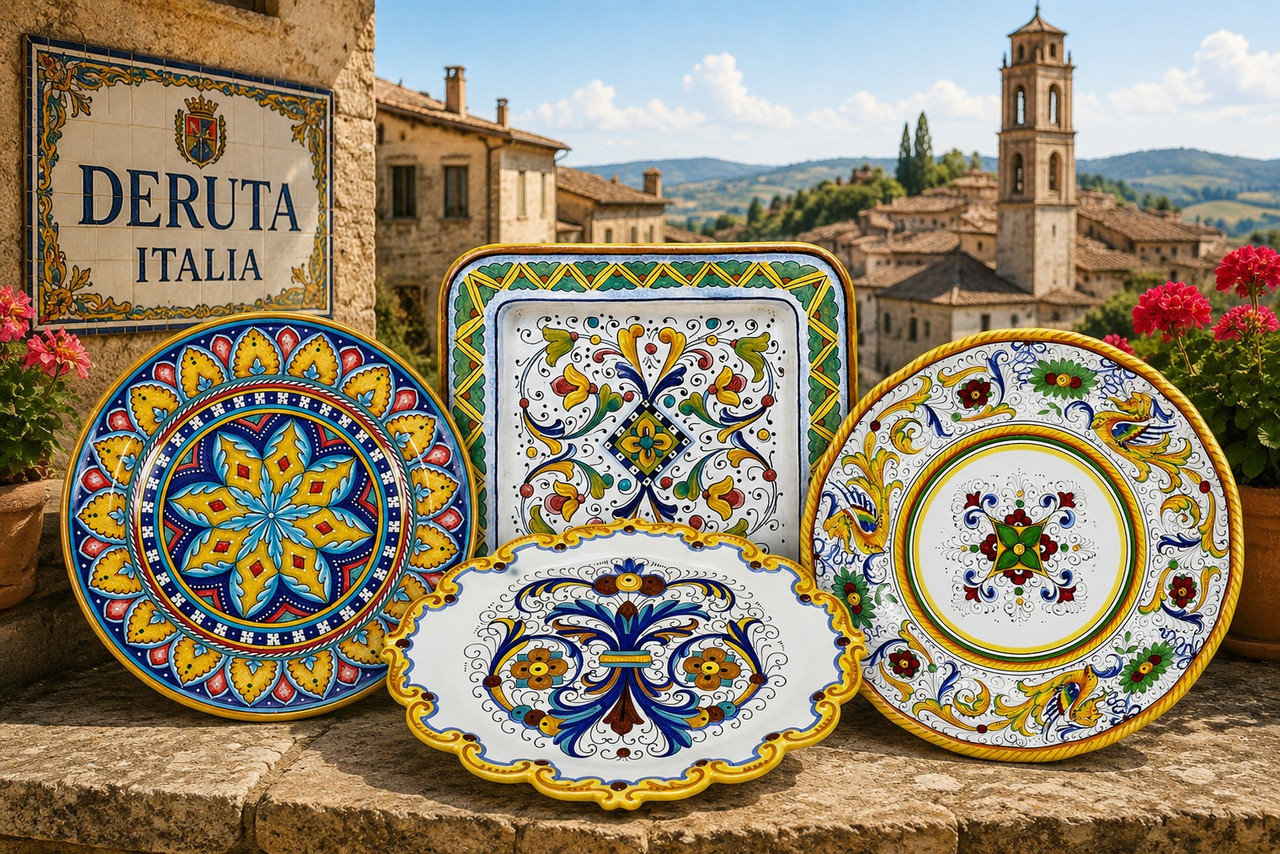
For centuries, the small Umbrian hill town of Deruta, Italy, has been celebrated for producing some of the world's most beautiful hand-painted ceramics.
Walk through Deruta today and you will still find ceramic workshops where artisans transform simple pieces of earthenware into brilliantly colored plates, bowls, platters, vases and decorative objects. Many of the techniques—and even some of the designs—have roots stretching back hundreds of years.
Known particularly for its maiolica, Deruta became one of Italy's most important centers of ceramic production during the Renaissance.
But the story of Deruta pottery began long before the Renaissance.
Where Is Deruta, Italy?
Deruta is a small hill town in Umbria, the green heart of central Italy. Located near Perugia and not far from Assisi, the town sits along the Tiber River.
Its location proved important to the development of its pottery industry. Local clay provided potters with the raw material they needed, while Deruta's position along important trade routes helped its ceramics eventually reach customers far beyond Umbria.
Ceramics had, of course, been made throughout Italy for thousands of years. Archaeological finds include pottery dating to the Etruscan, Greek and Roman periods.
In Deruta, however, pottery would eventually become much more than a practical craft.
It became the identity of the town.
The Beginning of Deruta Pottery
Ceramic production in Deruta can be traced to the Middle Ages, with archaeological evidence of kilns dating to around the end of the 13th century.
The earliest Deruta potters primarily produced practical household objects such as plates, bowls, jugs, pots, vases and storage vessels.
These early ceramics were considerably simpler than the elaborate Deruta pottery we recognize today. Decorations frequently consisted of geometric designs painted in a limited palette of earthy browns and greens.
As techniques improved, the range of colors expanded and the decoration became increasingly sophisticated.
By the 14th century, pottery had become sufficiently important to the local economy that Deruta's potters organized themselves into a Guild to regulate and protect their craft. By 1401, the first ceramic factory opened in Deruta, which was founded by Agostino di Antonio di Duccio, a pupil of Luca della Robbia.
A ceramic tradition was taking root that would ultimately make the name Deruta famous throughout Italy and beyond.
What Is Italian Maiolica?
One of the most important developments in Italian ceramic history was the introduction of maiolica.
Maiolica is a type of tin-glazed earthenware that provided Italian ceramic artists with something extremely valuable: a light, opaque surface on which they could paint colorful and highly detailed designs.
After the clay object was formed and initially fired, it was coated with an opaque glaze. The artisan then painted the decoration onto this surface using mineral pigments before the piece underwent another firing.
The resulting colors could be remarkably vivid.
Deep cobalt blue, emerald green, golden yellow, orange and other brilliant colors became characteristic of Italian maiolica.
The technique had connections to the Islamic ceramic traditions that reached Europe through Spain and the Mediterranean trade routes. Italian potters embraced and transformed these influences, eventually developing distinctive regional styles of their own.
Deruta became one of the most celebrated centers of this new ceramic art.
Deruta Pottery During the Italian Renaissance
The Renaissance transformed Deruta ceramics.
As wealth and artistic patronage expanded throughout Italy during the 15th and 16th centuries, ceramics were no longer created only as everyday household objects.
They also became works of art.
Deruta's potters began producing increasingly elaborate pieces intended for wealthy households, churches and important patrons.
Decorations became more intricate. Potters experimented with new forms, and painters incorporated Renaissance motifs including scrolling foliage, geometric borders, mythological figures, coats of arms, religious imagery and elaborate arabesques.
Deruta also became particularly famous for lustreware, a specialized technique that created shimmering metallic effects on the surface of ceramics.
By the 16th century, Deruta had entered what is generally considered the golden age of its ceramic production.
The Famous Designs of Deruta
Many patterns associated with Deruta pottery today draw inspiration from the decorative traditions that flourished during and after the Renaissance.
Two of the best-known are Ricco Deruta and Raffaellesco.
Ricco Deruta
The word ricco means "rich" in Italian—an appropriate description for this elaborate design.
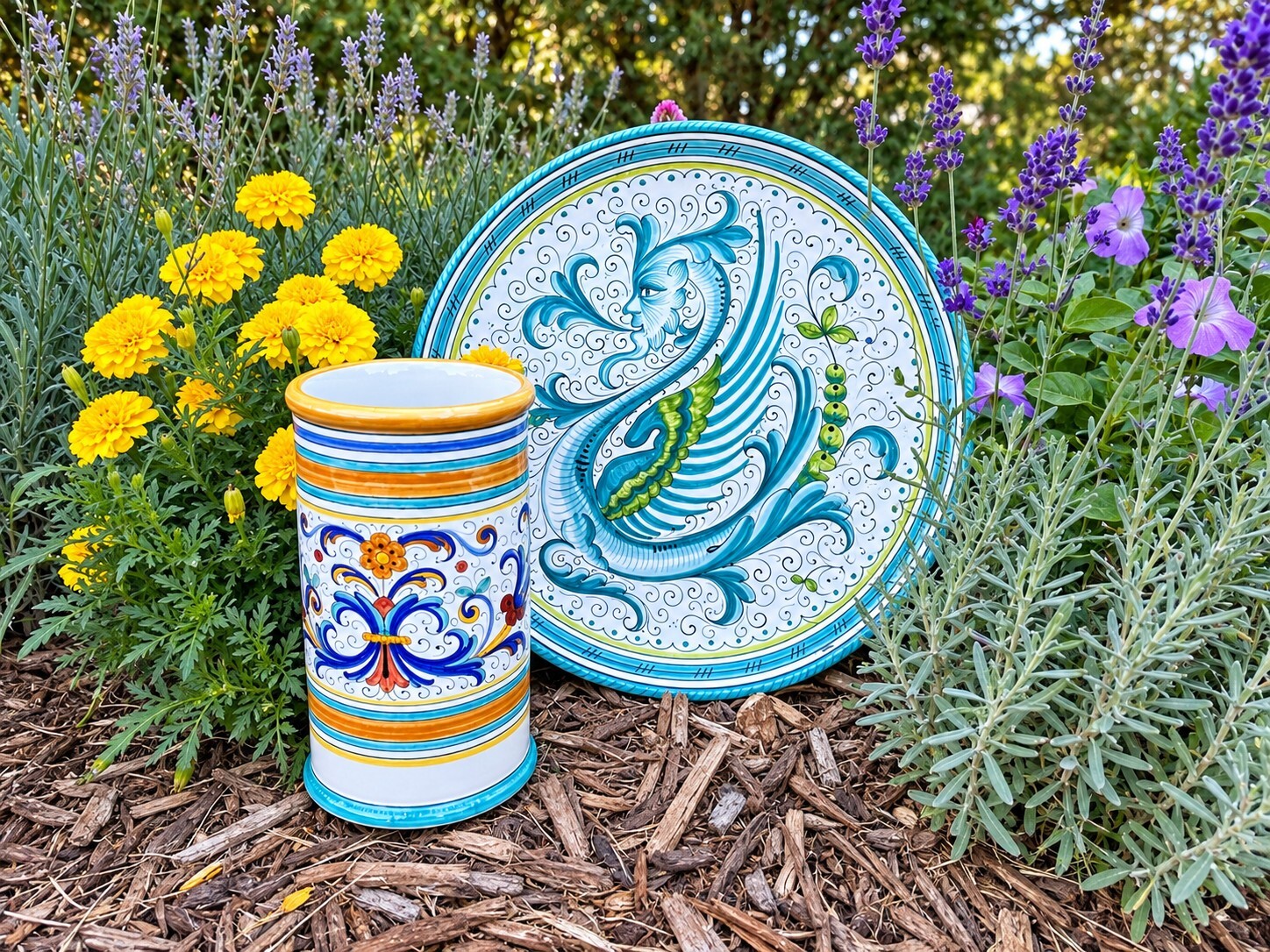
Ricco Deruta is characterized by beautifully balanced scrolling foliage and richly colored decoration traditionally painted in shades of royal blue, golden yellow and green.
Its Renaissance-inspired ornamentation has made it one of the most recognizable designs associated with Deruta ceramics.
Raffaellesco
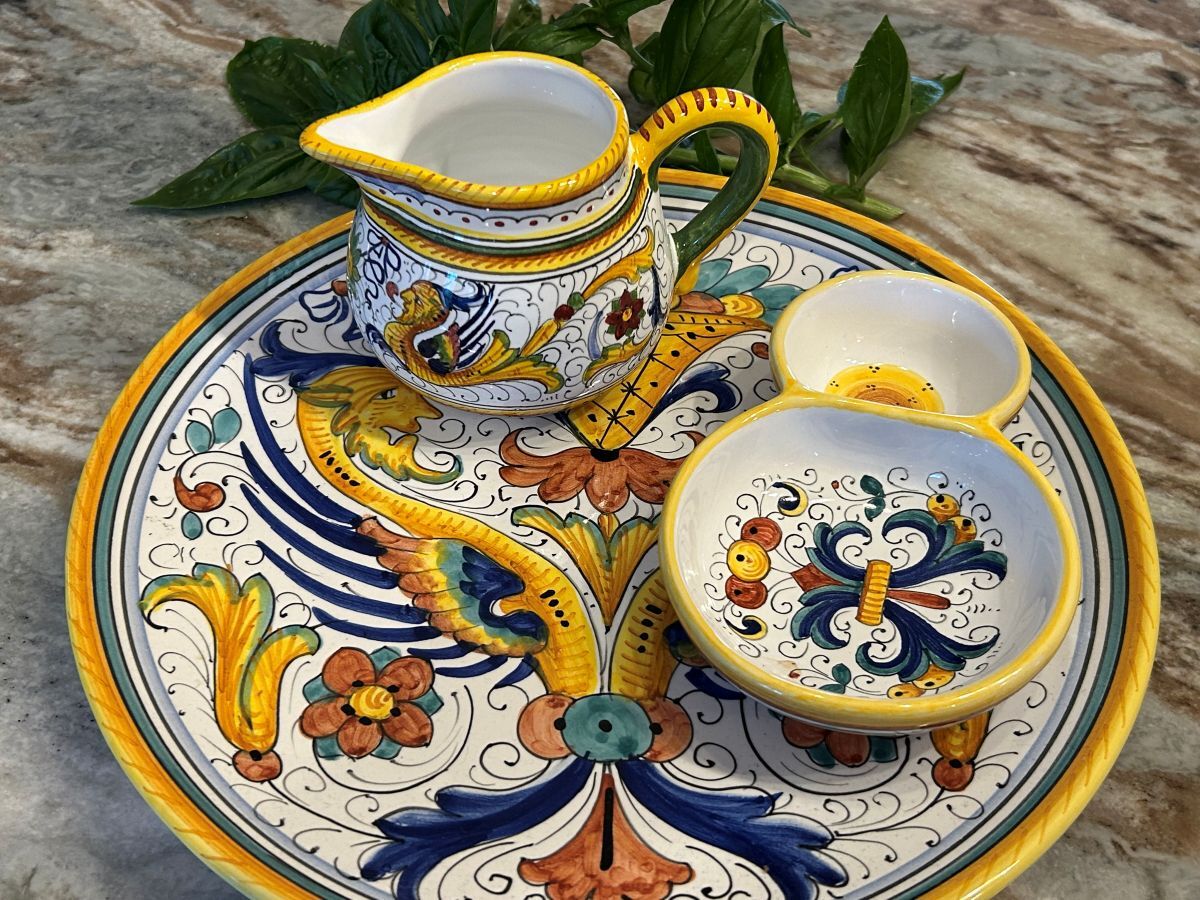
Perhaps no Deruta design is more immediately recognizable than Raffaellesco.
The pattern takes its inspiration from the elaborate grottesche decoration associated with Renaissance art and with the work of Raphael and his circle.
Its most famous feature is the colorful stylized dragon surrounded by graceful arabesques.
Today Raffaellesco remains one of the most popular patterns in traditional Italian pottery.
The Decline and Revival of Deruta Ceramics
Like many traditional European crafts, Deruta's ceramic industry experienced periods of both prosperity and decline.
After flourishing during the Renaissance and succeeding centuries, ceramic production diminished considerably during the 18th and 19th centuries as tastes, markets and economic conditions changed.
Fortunately, Deruta's ceramic heritage was not lost.
During the late 19th century/early 20th century, a revival occurred in Deruta to revamp their ceramic tradition. The establishment of the Museo Regionale della Ceramica in 1898 played a crucial role in preserving and revitalizing Deruta's ceramic traditions. In 1903, the Communal School of Design was founded to train a new generation of local artisans.
This was soon followed by the establishment in 1904 of the Società Anonima Maioliche Deruta, which was the first major enterprise to organize the town's small artisan workshops into a single unified manufacturing operation, managed by Giovanni Baiano. The Società was able to revive local trade with Rome and expand into the international market. By the 1970’s the factory closed due to financial difficulties. At this point, many employees from the factory opened their own workshops.
How Deruta Pottery Is Made Today
One of the wonderful things about authentic Deruta pottery is that the tradition remains very much alive.
Many pieces are still produced using techniques that would be recognizable to generations of earlier craftsmen.
Today though there are only about 9500 residents of Deruta, you will discover are over 200 factories/ workshops in Deruta producing ceramics. Each year over 20,000 tourists visit Deruta in search of beautiful Italian ceramics.
SHOP FOR DERUTA CERAMICS
Sources:
https://amaco.com/resources/lesson-plans/majolica-renaissance
Strafforello, Gustavo (1895). La patria; geografia dell'Italia. Provincia di Perugia. Unione Tipografico-Editrice. p. 38.
Newest Guide & Blog Updates

Nicchio is the Palio di Siena Winner!! – August 18, 2026
The Nobile Contrada del Nicchio has won the Palio di Siena Horse Race of August 18, 2026 with Jockey...

What Is Italian Espresso? The Coffee, the History & the Perfect Roast
When shopping for coffee beans for my espresso machine, I am often confused. I always buy “Espresso...
Deruta Pottery: History of Italy's Famous Hand-Painted Ceramics
For centuries, the small Umbrian hill town of Deruta, Italy, has been celebrated for producing some...
Palio di Siena Winners: Complete List of Past Winners & Contrade
First held in 1656, The Palio di Siena, otherwise known as "Il Palio", is one of the oldest and most...
Palio di Siena - The Winner of the July 2, 2026 is Aquila
The Nobile Contrada dell'Aquila (Aquila) won the Palio di Siena Horse Race July 2, 2026, which took...
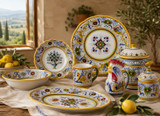
History of the Raffaellesco Deruta Pattern
The Raffaellesco pattern, renowned for its central motif of the benevolent dragon, surrounded by int...